
Field Notes #9: Aurora Shining
You are reading the weekly poetry newsletter, "Entangled Worlds: A Field Guide to Hope in a World Unraveling." Read more about it here.
Oh waylarks! Gather close. The fire glows in greens and spits white embers. Look how the sky shines. Look how the joyous cacophony of Peleides rains down the sparkling laughter of a comet. Look how the Snow Moon glows bright, encircled with an icy moonbow. The bone-seeping chill is setting in and the nights stretch and splinter our days, so I know, it’s hard to forget how the stars call to us. Amid such cold and barrenness, it feels as if the the hungry maw of white supremacist violence — murdered poets, kidnapped kindergartners, and the propaganda used to normalize it all — will swallow our starry-eyed gaze.
Nature does not understand such scarcity. Winter gives us the illusion of bareness, to be sure. The deer gnaw in hunger. The vultures swivel and swirl. And everything seems to lie brown and decaying. But there is also color blurting out in the bareness. The green shoots of grass sprout in the trickling spring-fed stream. The hibernating meadows - upon closer inspection - reveal a kaleidoscope of browns and purples and greens shining in the winter rays. Winter sunrises erupt in pinks and peaches, and auroras scream in psychedelic pinks between the bare tree branches.
So too, even in the bitter violence, there is the singing of organizers and the sweet sound of whistling.
Amid the literal whitewashing of our society, take the winter aurora’s silent-but-loud lesson: in a quiet world of white and grey, scream in pink.
Aurora Aurora Shining Bright
It starts as a blush on the horizon.
Look to the north
for the pinkish haze
that laughs at your mortal woes .
Then green beams shine above the hills
and undulate.
Then the entire sky
fractures
into columns of shining light
and all around you
the shadows
your soul
fills with an unearthly light
of pink and green.
You are made lighter
and seem to float
above the hills
skimming the stars
with fingertips
joined with something
changing but immortal
until the light slowly fades
to a whisper.
But the light burns upon your mortal gaze
and you think they will burn
your aged body one day
and somehow that light
will remain
in the ash of your eyes.

So for folks in the northern hemisphere, rejoice! We are a the peak of an 11 year cycle of solar activity - which means folks in more southern latitudes have the chance to view the aurora borealis.
When the sun emits a solar storm of unusually high solar radiation, two to three days later that storm hits the northern and southern magnetic poles. This interplay of solar radiation and earth’s magnetic field causes the auroras - Aurora Borealis in the northern hemisphere and Aurora Australis in the southern hemisphere
If a powerful solar storm is timed right with a lot of different factors, the aurora borealis extends further south than it usually does. Unfortunately, the powerful solar storms last November and then again a few weeks ago timed with poor viewing conditions where I live. But, two years ago, I had near-perfect conditions to view the aurora and planned a viewing party with friends to take in one of the waves that night.
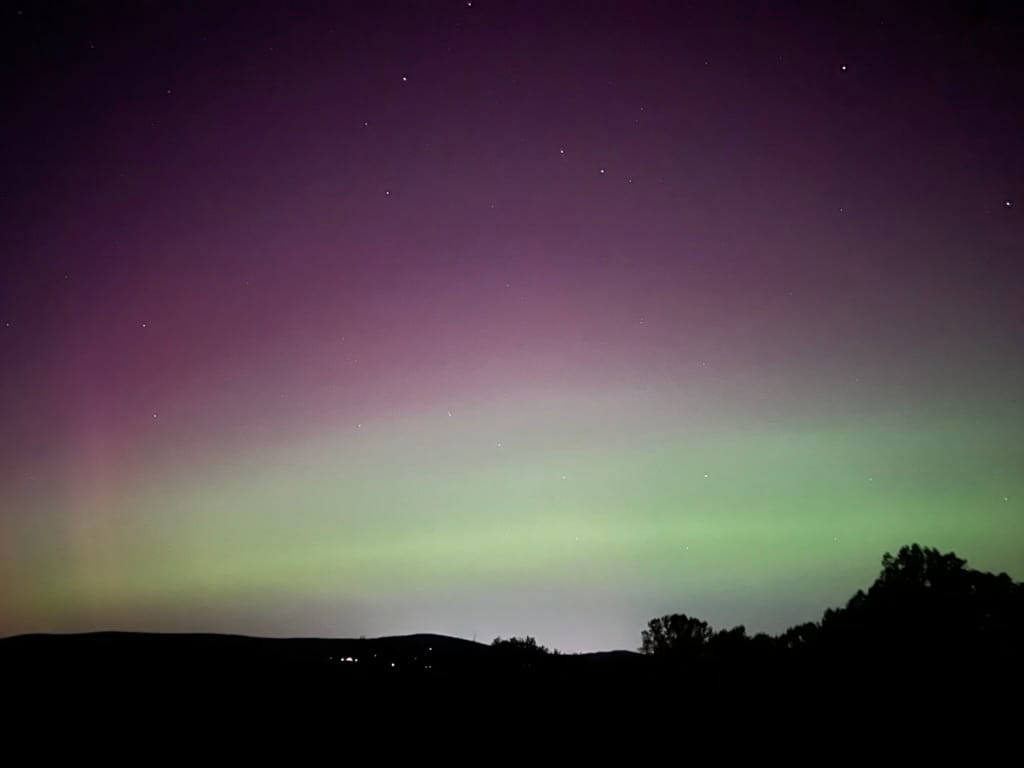
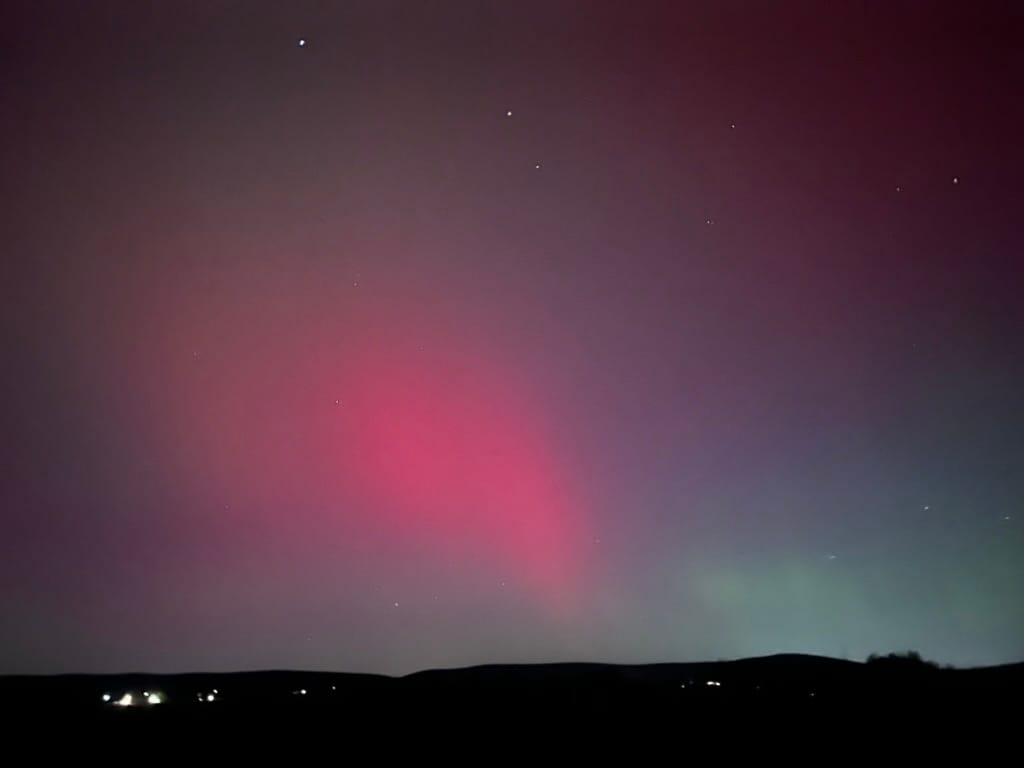
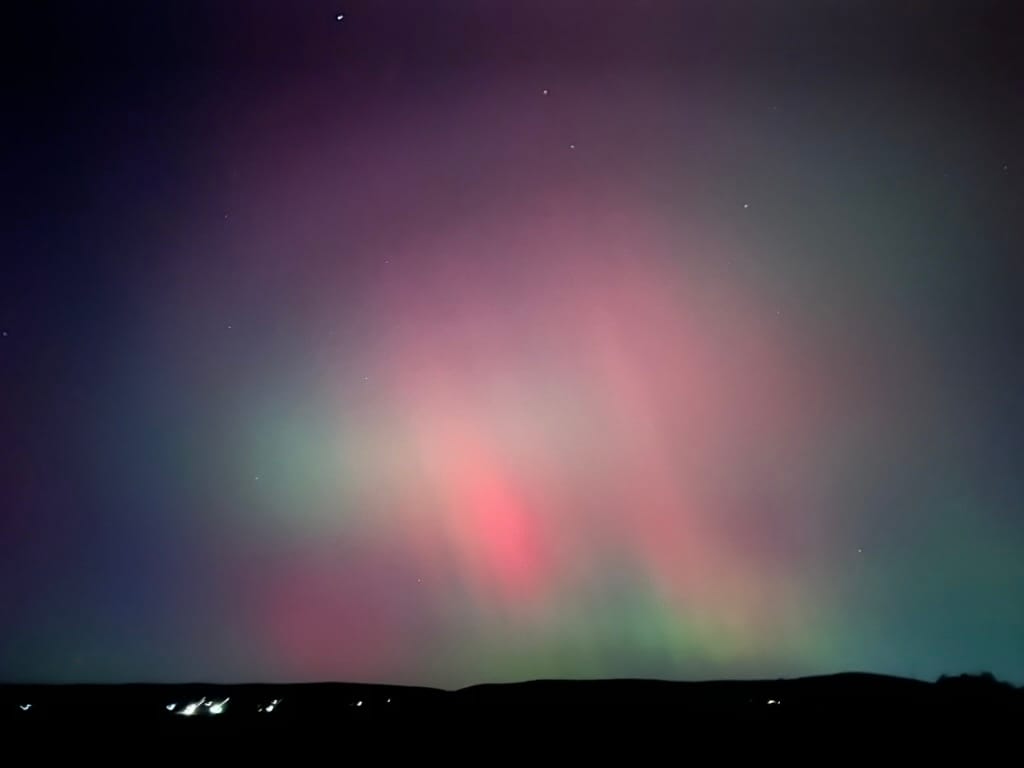
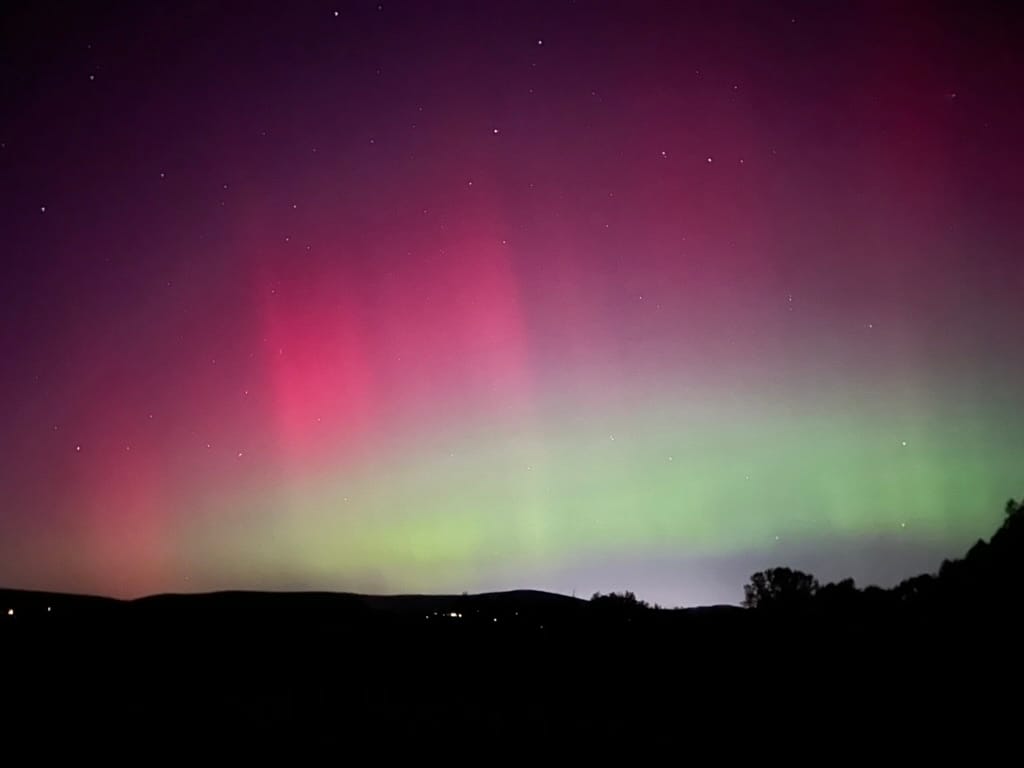
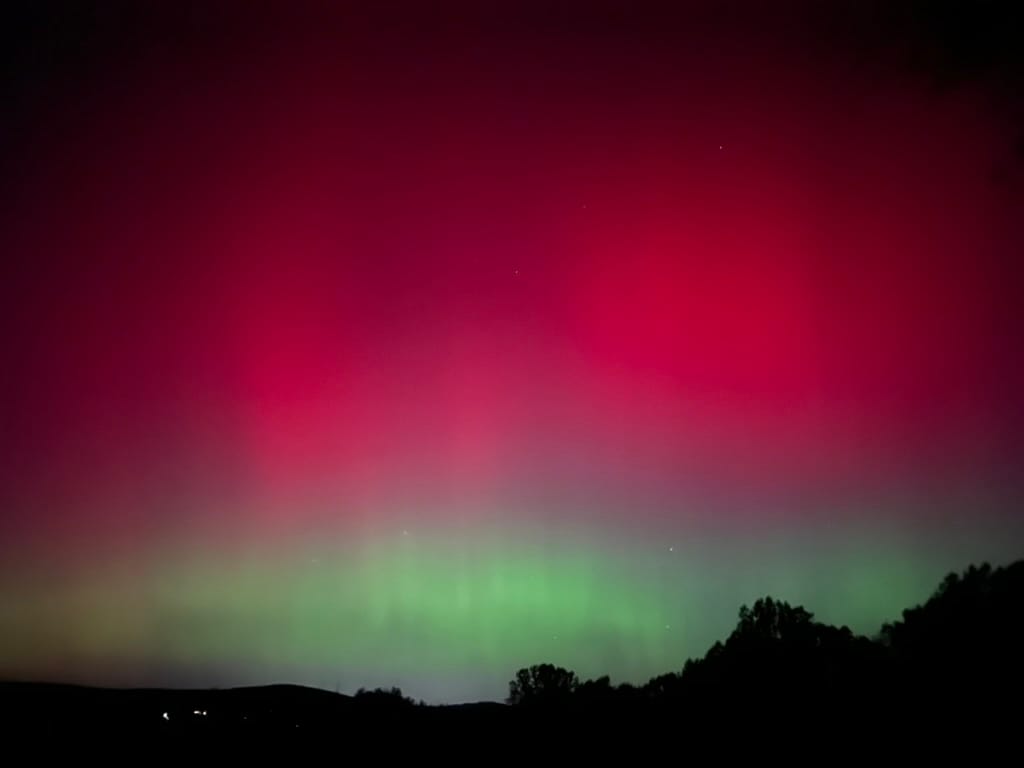
The aurora borealis from 9PM to about 10:30PM viewed from western Maryland in October 2024. | © N.A. Chapman
Meteorologists get a 1-3 day heads up for Aurora chances after a particularly high coronal mass ejection from the sun (G4-G5 storms on the scale). Typically you have about two subsequent nights of Aurora activity. Obviously you need to look to the northern horizon in an area with lower light pollution (though there are solar powerful enough to see in cities and suburbs). The colors come in waves every 2-3 hours throughout the night based on the time the solar radiation was emitted, and there’s a definitive bell-shaped curve of colors and intensity during that window. I saw the Aurora at about 9-11p.m. (with a peak around 10 p.m.) but had seen a wave at 6-7 p.m. and heard another wave happened around 1-3 a.m. that night.
You can stay tuned to space weather (yes, space weather!) through NOAA. In preparation and find an international dark sky park near you (which allow visitors after dusk) or another safe public area that hosts astronomy viewing events.
Subscribe for free below. Support if you can (starting at $10 a month).
Member discussion